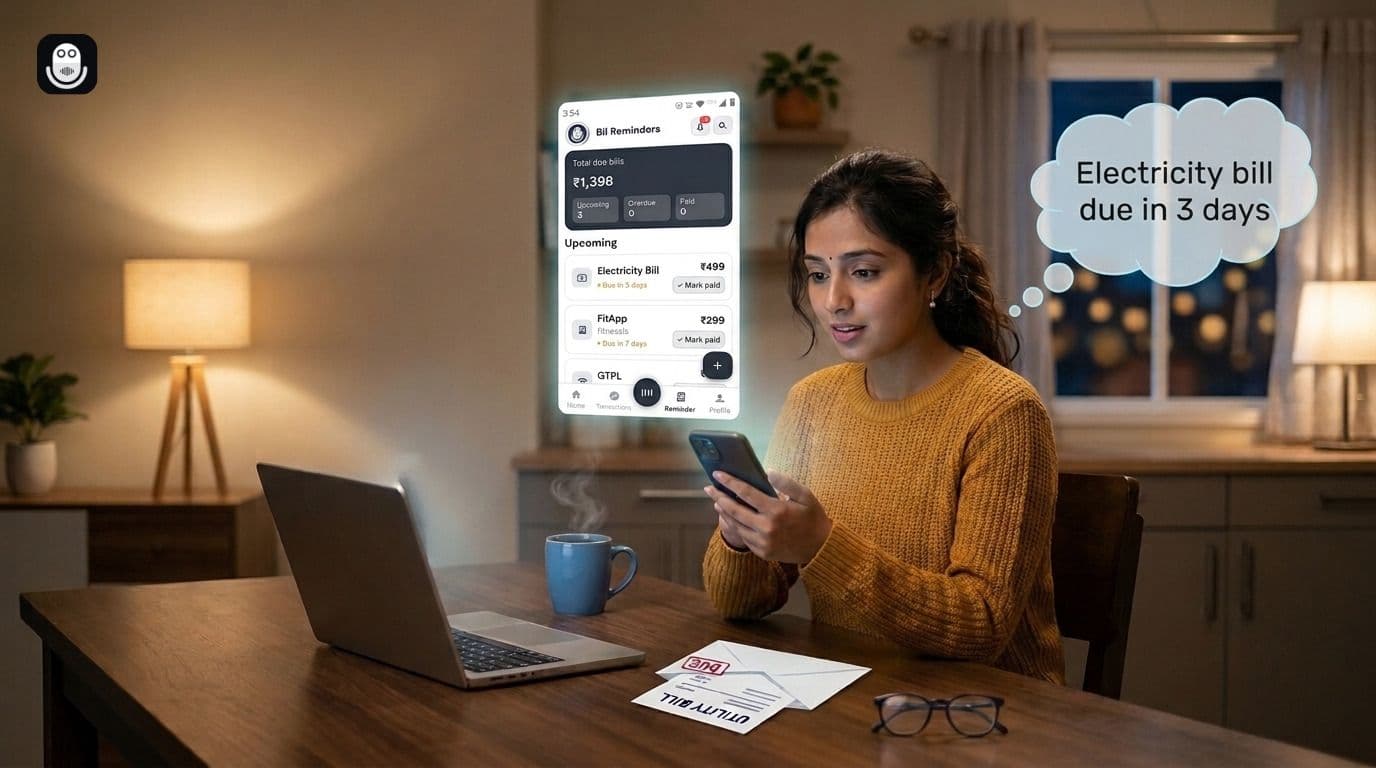
Beat Budget Burnout with Voice Budgeting

Voxpense-Team
·5 min read

The Two-Week Budgeting Graveyard
You download the budgeting app on a Monday morning, full of optimism.
This time will be different. This time you’ll stick with it.
You spend an hour setting up categories, inputting your accounts, configuring alerts. It feels productive. You open a spreadsheet and manually track three transactions. You feel accomplished.
By Wednesday, the app sits unused on your phone.
By the following Wednesday, you’ve deleted it entirely.
This is the reality for 72% of people who attempt budgeting: they give up within two weeks.
People don’t quit budgeting because they lack willpower—they quit because it feels like a second job, leading to burnout.
Why Budget Burnout?
Traditional budgeting requires a cascade of micro-decisions and manual labor:
Week 1:
- Set up accounts and link them
- Define spending categories
- Input historical data
- Configure alerts
- Create savings targets
Then continuously:
- Remember to check the app
- Manually enter transactions
- Categorize purchases
- Review progress
- Adjust allocations
- Analyze reports
Every budgeting task demands your attention, interrupts your workflow, and adds unnecessary friction.
By the second week, your decision-making capacity is depleted. The app starts to feel like an obligation rather than a tool. And obligations that don’t feel immediately rewarding get abandoned.
Research from Stanford University found that people are 46% more likely to quit digital habits if they require more than 60 seconds of interaction per use. Traditional budgeting apps? They require 2-5 minutes per session.
That’s why you quit.
The Budget Paradox
Here’s the paradox at the heart of modern budgeting:
The people most stressed about money are the people least able to afford the time to manage it.
If you’re:
- Working multiple jobs
- Managing a business
- Raising kids
- Handling emergencies
- Dealing with life chaos
Then budgeting is the last thing you have mental bandwidth for.
Yet those are exactly the people who need budgeting most.
Traditional apps assume you have 20-30 minutes per week to dedicate to money management. But if you’re already overwhelmed, that’s an impossible ask.
You don’t need a powerful budgeting tool. You need a frictionless one.
Why Voice is the Antidote to Budget Burnout
Voice input changes everything about budget simplicity.
Think about how you currently budget:
- Open app
- Navigate to transaction entry
- Type merchant name
- Select category (from list of 15-20)
- Enter amount
- Confirm
That’s 6 steps, 45-60 seconds.
Compare to voice:
- Say “Today I spend 6.50 on coffee”
That’s 1 step, 3 seconds.
But the difference isn’t just speed. It’s psychological.
When something takes 3 seconds, it doesn’t feel like a task. It feels like talking. Your brain doesn’t categorize it as “work” or “obligation.” It’s as natural as telling a friend what you spent.
This is why voice-based budgeting eliminates burnout. You’re not using an app. You’re talking.
And talking requires virtually zero friction.
The Low-Effort Money Tracking Revolution
Instead, an easy budget planner isn’t defined by features—it’s defined by how little effort it requires.
A good budget planner should:
Require minimal time per interaction (under 5 seconds)
Voice commands achieve this. No typing, no navigation, just speak.
Require minimal cognitive load (no category selection)
The app learns your merchants and auto-categorizes. “Coffee” automatically becomes “Dining: Beverages.”
Require minimal setup (use defaults)
Don’t ask users to create 20 categories. Provide smart defaults. They can customize later if they want.
Require minimal maintenance (set and forget)
Once configured, the budget should run itself. Alerts when you exceed limits. That’s it.
Provide maximum insight (visual, digestible)
Show spending breakdown at a glance. No detailed reports required. Just: “You’ve spent $X of your $Y budget this month.”
This is what low-effort money tracking actually means.
How Voxpense Eliminates Budget Burnout

Voxpense was specifically designed to eliminate every friction point that causes budget burnout:
Voice Input: Instead of typing, you talk. “Today Spend 12.50 on lunch.” Logged instantly. No friction.
Automatic Categorization: The app learns that Starbucks = Dining, Shell Gas = Transportation, Uber = Rideshare. You don’t decide. It remembers.
One-Tap Dashboard: See your budget status instantly. No digging through reports. Just: “Budget: 45% spent, 55% remaining.”
Smart Defaults: Standard budget categories pre-loaded. Advanced users can customize. Beginners can use as-is.
Set-and-Forget Alerts: Alert when approaching category limit. Alert when unusual spending is detected. Otherwise, silence. You’re not bothered constantly.
Week-by-Week Progress: See how the week is going. Adjust behavior in real-time. No waiting for month-end.
Ultimately, the entire experience is designed around one principle: budgeting should require as little effort as possible.
Because the less effort required, the more likely you’ll actually maintain it.
The Real Cost of Budget Burnout
What does it cost when you quit budgeting?
Financial Cost:
- Overspending goes unnoticed
- Budget optimization never happens
- Savings targets remain unmet
- Average person leaves $3,000-5,000 per year on the table
Psychological Cost:
- Ongoing financial anxiety
- Shame about poor money management
- Decision fatigue from ad-hoc spending
Opportunity Cost:
- Money that could have been invested grows elsewhere
- Financial freedom pushed further away
- Stress compounds over years
The Alternative: With voice-based budgeting, you maintain the habit because maintenance is effortless.
One 3-second voice command per purchase. That’s it.
Over a year, that’s:
- 365 purchases logged
- <30 minutes total time investment
- Perfect financial visibility
- $3,000-5,000 reclaimed through optimized spending
30 minutes of voice commands beats years of financial stress.
If You Can Talk, You Can Budget
This is the core idea: budgeting complexity is a myth.
Budgeting isn’t complicated. Budgeting apps are complicated.
In fact, the act of budgeting—knowing what you spent and where—is simple, even trivial.
You already know if you had a good financial week or a bad one. You just don’t have visibility into why.
Instead, voice-based budgeting gives you that visibility without the work.
You don’t need to be a financial expert—you just need to talk.
That’s literally it.
Say what you spent, when you spent it, and the app handles the rest: categorization, tracking, insights, alerts.
This is the definition of simplifying your finances—not making budgeting more powerful, but making it more human.
Start Where You Are
You don’t need to:
- Read financial books
- Take a budgeting course
- Create complex spreadsheets
- Optimize every category
- Become a money expert
You just need to:
- Download an app
- Say what you spent
- Watch your budget come together automatically
That’s it. That’s the entire system.
If you’ve quit budgeting before—this time is different. Because this tool was built for people like you: busy, overwhelmed, skeptical of complex systems.
Voxpense isn’t for financial experts. It’s for everyone else.
Ready to Beat Budget Burnout?
Start Your Free Trial – No Complexity, Just Voice
Join thousands who finally stuck with their budget—because it actually works with their life, not against it.