Voxpense – Single-Handed Expense Manager for Busy Lives

Voxpense-Team
·13 min read

The $47 Latte You Don’t Remember Buying
You pull up your credit card statement on Monday evening. There it is: Starbucks, $6.80. Again. But you can’t remember which day you bought it.
Then another one: $6.45. And another: $7.20.
Three lattes from last week alone: twenty dollars you didn’t consciously spend. And that’s just coffee.
Scroll down further: parking meters ($5), lunch from that food truck ($12), gas station snacks ($8), rideshare services ($23), delivery app fees ($6), a quick pharmacy run ($15).
By Friday, you’ve spent $121 on small purchases you barely remember making. At the end of the month, that’s nearly $500 in “forgotten” micro-transactions.
But here’s the real problem: You didn’t budget for any of it. Your financial plan assumed you’d spend $80 on dining out. You actually spent $200. Your budget for transportation was $120. You spent $185.
These small, frequent expenses aren’t individually significant. But collectively, they’re sabotaging your budget and destroying your financial plan.
And the worst part? You can’t even remember where the money went.
Financial experts call this the “invisible money leak.” Micro-transactions—small purchases under $20 are the ones most frequently forgotten because of a simple principle: if it doesn’t feel like a purchase, you don’t mentally budget for it.
The Forgotten Economy: Why Micro-Transactions Are Invisible
Your brain evolved to remember big, intentional purchases. When you buy a laptop for $1,200, you consciously decide to do it. It’s a purchase. It gets filed away in your memory as “that time I bought a computer.”
But a $6 coffee? Your brain doesn’t register it the same way. You’re focused on the meeting ahead, the email you need to send, getting the kids to school on time. The coffee is incidental, a vehicle for caffeine, not a transaction worth remembering.
Why Micro-Transactions Are Getting Worse
The last decade has transformed how we spend money. Our daily lives have shifted from occasional spending to frequent, recurring expenses, from coffee runs and rideshares to managing multiple subscriptions every month.
The frequency has increased exponentially. And with each increase in frequency comes a decrease in conscious awareness.
Research from the Journal of Consumer Psychology shows that:
- 90% of people accurately remember large purchases ($100+)
- 60% of people accurately remember medium purchases ($20-100)
- Only 15% of people accurately remember micro-transactions (under $20)
This isn’t laziness or lack of discipline. It’s a limitation of human working memory combined with modern spending patterns designed to be frictionless. Every company optimizing their payment process to be as easy as possible has made it easier for you to spend money without thinking about it.
You can now:
- Tap your phone once for coffee
- Say “Alexa, order that product”
- Subscribe to services with a single click
- Use one-touch payment buttons
- Auto-pay recurring charges
Each optimization makes spending easier and less cognitively taxing. The result: you spend more money on things you barely notice spending money on.
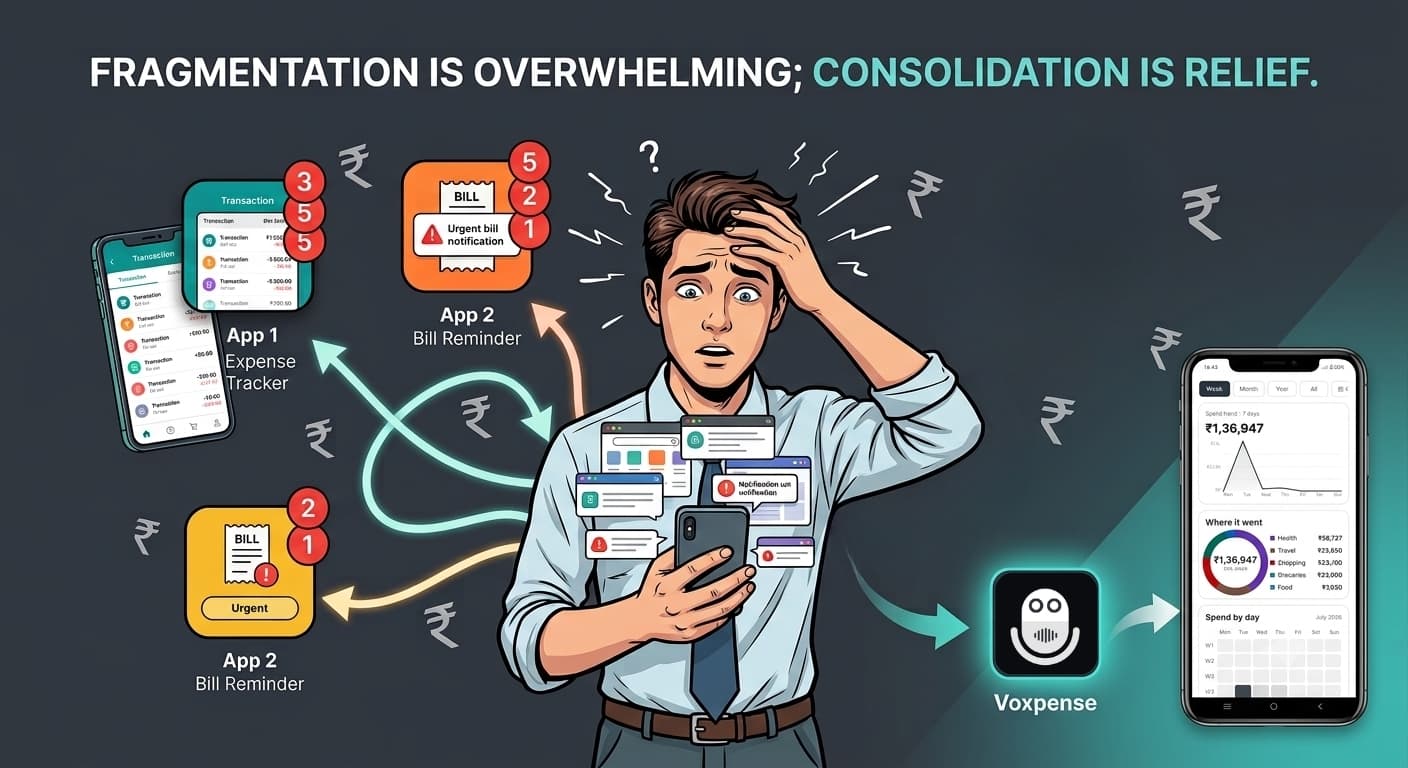
Busy People Need Better Than Traditional Expense Trackers
You know you should track your spending. You’ve probably tried.
Most people have tried at least three different expense tracking methods:
1) The Phone Notes App Approach!
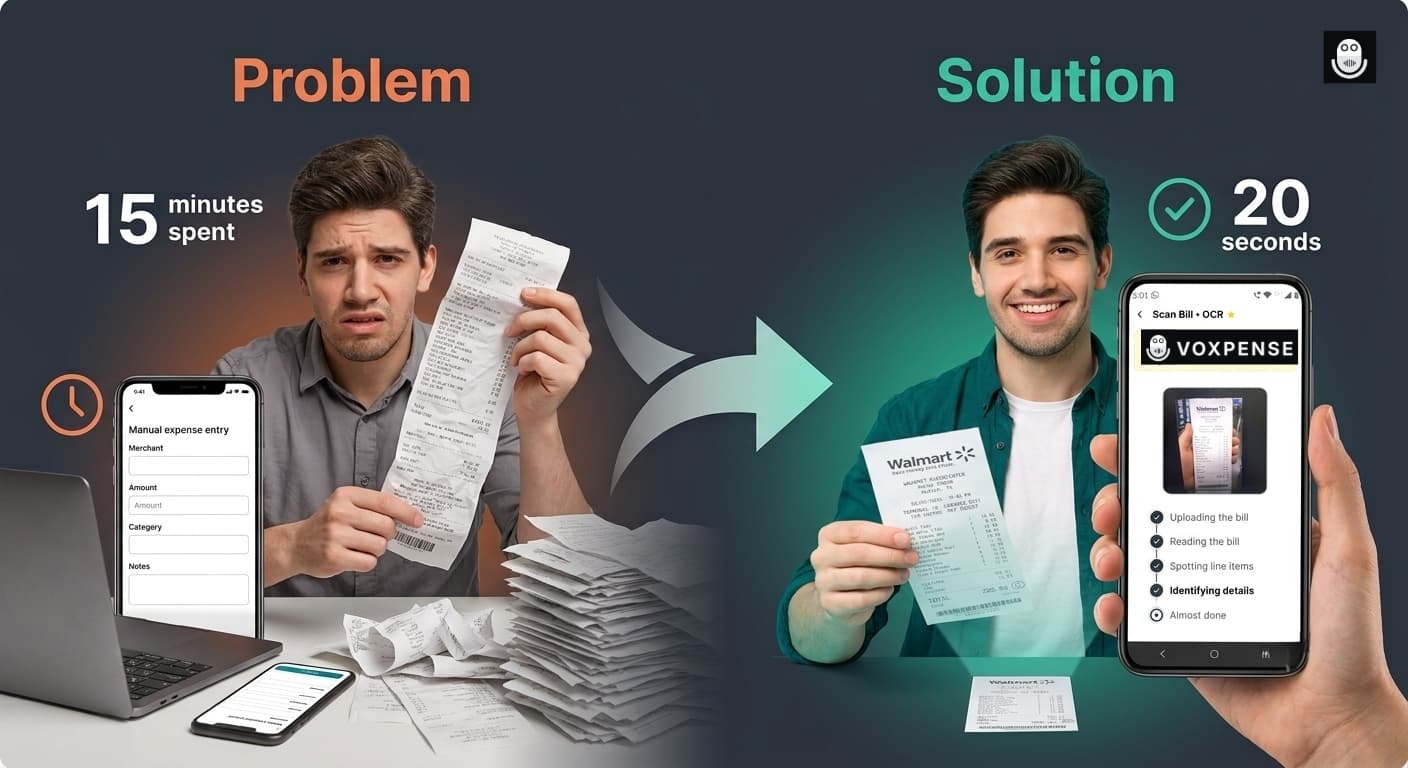
You decide to jot down every expense in your notes app. “Great system!” you think on day 1. By day 5, you’re at a coffee shop and remember you should write down last week’s expenses. You scribble seven purchases down that you can’t quite remember. By day 15, you’ve given up because this requires you to stop what you’re doing, pull out your phone, open the app, remember what that $15 charge was for, type it in, categorize it, and continue your day.
That friction that cognitive and physical burden is unsustainable when you’re already juggling 47 other things.
2) The Receipt Collection Approach!
You’ll collect all your receipts and input them on Sunday! You probably make it one Sunday before you realize:
- Half your receipts are missing (they’re tiny)
- You have 40 receipts to input by hand
- Inputting 40 receipts takes 45-60 minutes
- Your Sunday got consumed by data entry
- The next Sunday, you skip it because you’re tired
3) The Credit Card Statement Approach!
You’ll just look at your credit card statement at month-end and see where the money went. But this is pure reaction. By then:
- You can’t change the behavior (money already spent)
- You can’t remember the context (what was that $47 charge for?)
- You can’t do any real budgeting (too late to adjust)
- You can’t create better habits (disconnected from actual spending)
The Spreadsheet Approach:
Excel! Google Sheets! The most organized system! You create a beautiful spreadsheet with categories, color coding, and formulas. Then:
- Pulling out your laptop to log a $6 coffee is worse than noting it.
- Sync issues between devices create duplicates and confusion.
- Manual entry errors happen constantly.
- One wrong number throws off your whole system.
- The cognitive burden increases as the spreadsheet gets bigger.
Why All These Fail:
Every traditional expense tracking method assumes you have time to stop what you’re doing to log an expense.
But you don’t. You’re:
- Driving to work
- In the middle of a client call
- Picking up kids from school
- Between meetings
- Handling a crisis at work
- Dealing with an emergency
In that moment while you’re actually spending money, the last thing you want to do is pull out a device, navigate an app, and manually input data.
The solution most “busy people” choose? Don’t track it. Just hope you can remember or estimate it at month-end.
The Voxpense – (Single-Handed Expense Manager): A Better Solution
Logging an expense shouldn’t interrupt your day. It should happen while you’re commuting, between meetings, or even when your hands are full. Instead of manually typing every detail, your expenses could be categorized automatically. Better yet, the entire process could take just 2–5 seconds instead of 30–60 seconds.
That’s the entire concept of a Voxpense – an app designed for the reality of busy people’s lives.
The Problem With Traditional Apps
Traditional budgeting apps were designed for a different era. They assume:
- You have time to sit down and log expenses
- You’ll remember details about past purchases
- You want to manually type information
- You prefer precise categories you’ve set up
- You’re using a device with two hands
But modern life doesn’t work that way.
A proper fast expense tracker needs to:
1. Require Minimal Interaction: Not clicking through 3 screens. Not selecting from 20 categories. Not typing detailed notes. Just: open, log, close. Ideally 2-5 seconds max.
2. Work One-Handed: You’re holding a coffee, steering a car, carrying groceries, or rocking a baby. The app needs to work when you have only one free hand.
3. Accept Voice Input: The fastest way to input data when your hands are busy is with your voice. “Coffee, 6.50, Starbucks” should log the transaction in real-time.
4. Learn Your Patterns:
The app should remember:
- Where you usually spend money (Starbucks, not “coffee shop #47”)
- How much you usually spend
- What category it belongs to
- Common merchants and amounts
5. Categorize Automatically: If you say “Starbucks 6.50,” it should know:
- Merchant: Starbucks
- Category: Dining/Beverages
- Amount: $6.50
- Date/time: No manual selection required.
6. Sync Across Devices: You should be able to log an expense on your phone. Everything syncs to give you a real-time view of spending.
What A Voxpense – Expense Manager Actually Does
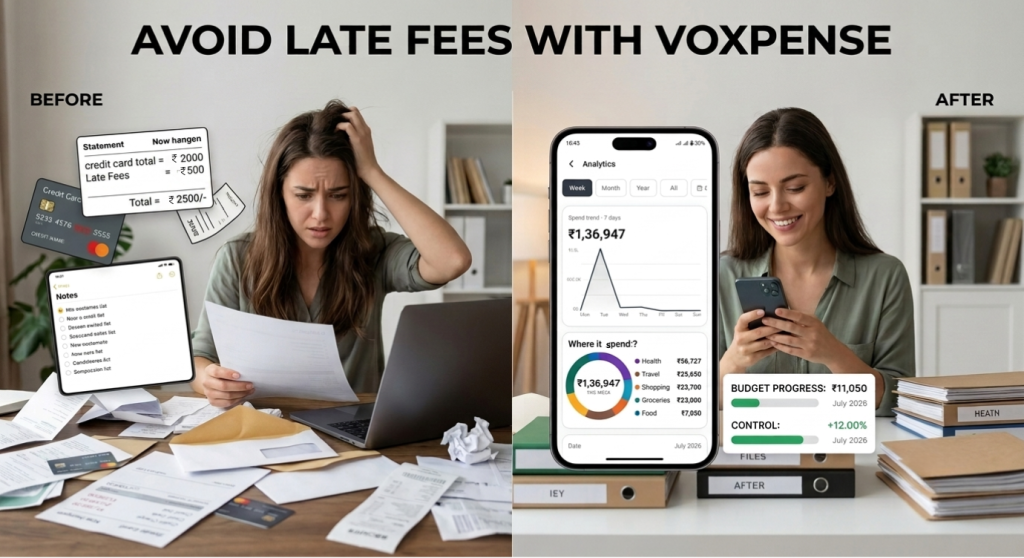
A proper on-the-go budget app changes the experience completely:
Before (Traditional App):
Purchase coffee at Starbucks
↓
Remember to log it (maybe)
↓
Stop what you’re doing
↓
Pull out phone
↓
Open app
↓
Tap “Add Expense”
↓
Type “Starbucks” (spell it out)
↓
Select from categories: Food? Dining? Beverages?
↓
Enter $6.80
↓
Add note? (optional, usually skip)
↓
Confirm and save
↓
Close app
↓
Resume what you were doing
TIME: 45-60 seconds
FRICTION: Very high
HABIT FORMATION: Low (you’ll skip most transactions)
After (With Voxpense Expense Manager):
Purchase coffee at Starbucks
↓
While walking/driving/busy: ” Spend 6.50 on Starbucks coffee “
↓
App logs it instantly
↓
Continues learning your spending
↓
Resume what you were doing
TIME: 2-5 seconds
FRICTION: Virtually none
HABIT FORMATION: High (you’ll log almost everything)
How Voxpense – Voice-Activated Expense Tracking Changes Everything
The Science of Frictionless Habits
Behavioral psychologist B.J. Fogg has researched habit formation for 20 years. His core finding: tiny behaviors are more likely to become habits than ambitious behaviors.
He discovered a principle called “Habit = Motivation × Ability × Prompt”
For expense tracking:
- Motivation: You want to understand your spending (moderate)
- Ability: Traditional app has high friction (low ability)
- Prompt: Spending naturally prompts tracking (high)
Low ability × existing prompt = Low habit formation rate
But with a Voxpense – expense manager:
- Motivation: Still moderate
- Ability: Incredibly easy, no friction (high ability)
- Prompt: Spending naturally prompts tracking (high)
High ability × existing prompt = High habit formation rate!
This is why voice-activated tracking works for busy people: it removes the friction that prevents habit formation.
The Real-Time Budget Visibility Advantage:
When you track expenses as they happen (not at month-end):
You see patterns immediately. After a week, you might realize: “Wait, I’ve spent $40 on coffee already? That’s more than I thought.”
This immediate feedback triggers behavioral change faster than any month-end analysis.
You can make real-time adjustments. Instead of discovering you’ve overspent on dining at month-end (when it’s too late), you see it by Wednesday and adjust your behavior for the rest of the week.
You build better financial intuition. When you’re constantly logging small expenses, you develop a more accurate sense of “what things cost” and “how much I actually spend.”
You can catch fraud immediately. See an expense you didn’t make? Flag it instantly instead of discovering it on your statement weeks later.
You maintain budget discipline. When you’re seeing your spending in real-time, it’s much harder to rationalize overspending in any category.
The Hidden Problem With Micro-Transactions: The Behavioral Drift
There’s something else happening with forgotten micro-transactions that’s even more insidious than the financial cost.
Spending creates momentum.
Once you’ve bought one expensive coffee, the mental resistance to buying another drops. “I already spent $7 today, so another $7 isn’t that much worse.”
This is called decision fatigue threshold displacement. After you make one purchasing decision in a category, your willpower for that category decreases with each additional decision.
Here’s a smoother version with transition words for better readability:
Psychologists call it the “what-the-hell effect”: “I’ve already broken my budget, so what the hell, I might as well eat out tonight too.”
As a result, if you can’t see your spending accumulating, this effect becomes even stronger. For example, you might spend $40 on coffee by Friday without realizing it because each individual purchase feels too small to notice. Over time, those seemingly insignificant expenses quietly add up, making it easier to overspend without realizing it.
But when you’re tracking in real-time:
- After the first coffee, you see: $6.50 logged
- After the second, you see: $13 total
- After the third, you see: $19.50 total
- By the fourth, you see: $25.50 and think “Wait, that’s way too much”
As a result, the visible accumulation triggers behavioral correction before it becomes a pattern.
Voxpense: The Ultimate Single-Handed Expense Manager
To solve this problem, Voxpense was specifically designed for the modern busy person. It solves every problem that makes traditional expense tracking fail.
Key Features of Voxpense Tracking:
1. Voice-Activated Logging – Simply say:
- “Spend 6.50 on Coffee “
- “Paid 5 for parking”
- “Spend 12.95 on lunch, Chipotle”
The app understands conversational input and logs it instantly. No typing required.
2. Merchant Recognition: Voxpense learns the merchants you frequent:
- “Starbucks 6.50” → Automatically categorized as “Dining: Beverages”
- “Chevron 45” → Automatically categorized as “Transportation: Gas”
- “Uber 23” → Automatically categorized as “Transportation: Rideshare”
After a few uses, you can just say “Starbucks 6,” and the app fills in the category and merchant details.
3. Smart Categorization: You define your budget categories (or use defaults), then Voxpense learns:
- What falls into each category
- Your spending patterns by category
- Which merchants belong where
- Common amounts and frequencies
4. Real-Time Budget Dashboard: See at a glance:
- Total spent this month
- By category breakdown
- In comparison to your budget
- How much you have left to spend
- Trends and patterns
5. Multi-Device Support: Log expenses from:
- Your phone (easiest for most transactions)
- Voice assistants (Alexa, Google Assistant integration)
6. Insights and Analytics: Instead of just tracking expenses, Voxpense provides actionable insights to help you make smarter financial decisions.
- Spending trends over time
- Category analysis (where’s most of your money going?)
- Merchant analysis (which stores do you visit most?)
- Behavioral insights (“You’ve increased dining 23% this month”)
- Forecasting (at current rate, you’ll spend X this month)
How Voxpense Fits Into Your Busy Lifestyle
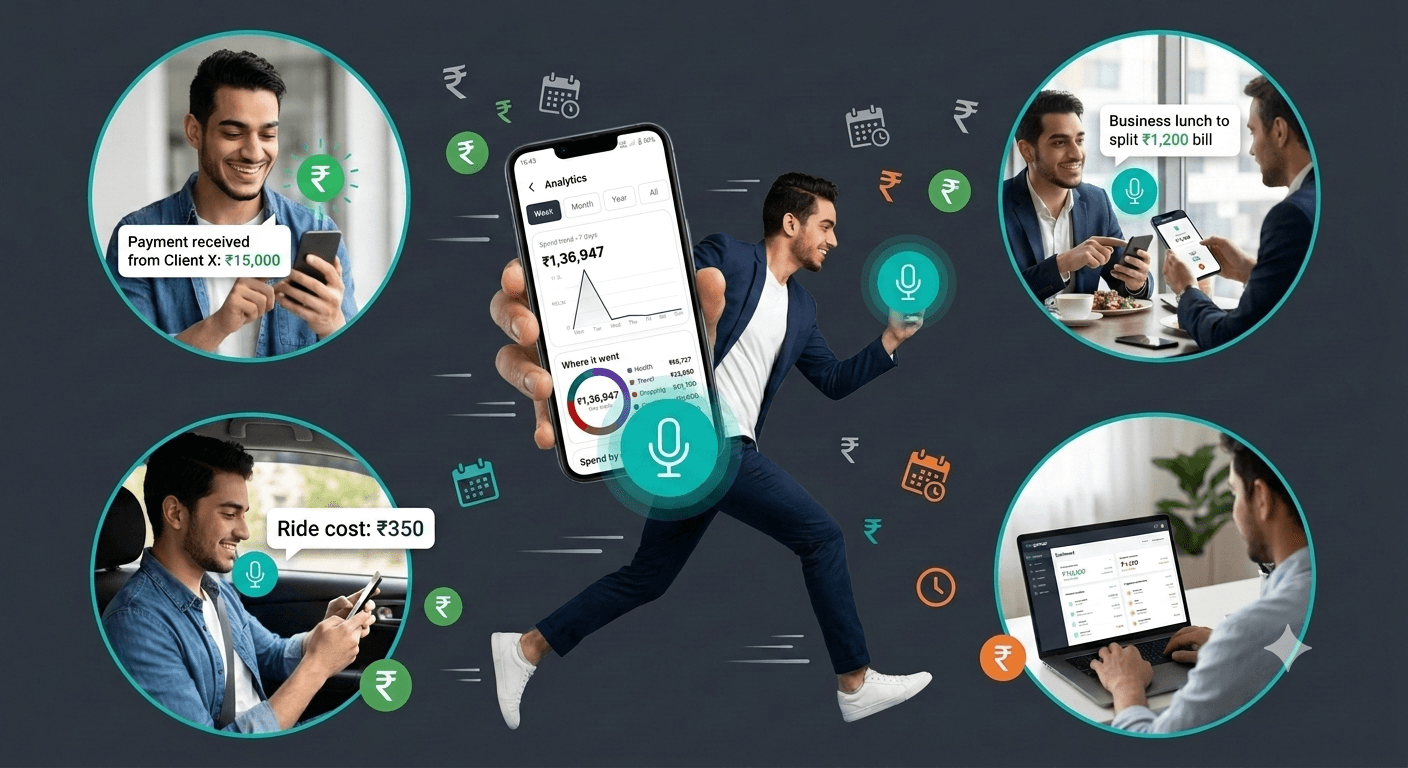
For Busy Professionals
You’re constantly in meetings, between calls, managing multiple projects.
Traditional expense tracking asks: “Do you have 30-60 minutes to input expenses?”
Rather than interrupting your day, Voxpense asks: “Can you say five words while walking between meetings?”
Scenario:
- 9:15 AM: “Spend 6.50 on Coffee, Starbucks”
- 12:45 PM: “Paid for Lunch, 14.20, Panda Express”
- 6:30 PM: “Uber, 18, ride home”
Total time: 20 seconds across the entire day. Traditional app time: 3-5 minutes. Difference: You actually track 90% vs. remembering 40%
For Busy Parents
You’re managing kids’ schedules, activities, meals, emergencies.
Voxpense works one-handed while you’re holding a toddler, steering a car, or cooking dinner.
Scenario:
- “Starbucks, 5.50” (while at school pickup)
- “Gas, 48” (while filling up, kids in car)
- “Grocery, 73” (while pushing cart)
Traditional app requires: Two hands, attention, 3-5 minutes. Voxpense requires: One hand, 5 seconds per transaction.
For Gig Workers
You’re constantly paid different amounts, at different times, for different work. You need to track expenses against income in real time.
You’re constantly paid different amounts, at different times, for different work. You need to track expenses against income in real-time.
Voxpense’s merchant and category learning adapts to your unique spending patterns:
- Tool/equipment expenses
- Work-related meals
- Professional services
- Travel costs
Real-time tracking means you can see the expense as it happens, not at tax time.
How to Choose the Right On-The-Go Budget App
If you’re serious about tracking micro-transactions while staying busy, look for these features:
1. Voice Input Capability
- Must support natural language
- Should recognize common phrases
- Should learn your preferences
2. One-Handed Operation
- Thumb-friendly interface
- Large, easy-to-tap buttons
- Minimal navigation layers
3. Fast Expense Entry
- Ideally <5 seconds per transaction
- Minimal typing required
- Smart category suggestions
- Quick confirmation (don’t make them verify 5 times)
4. Automatic Categorization
- Learns your spending patterns
- Recognizes merchants
- Suggests categories
- Allows quick customization
5. Real-Time Visibility
- Current month total always visible
- Budget progress shown clearly
- Category breakdowns quick to access
- Trends immediately apparent
6. Multi-Device Sync
- Works across phone/web/tablet
- Instant syncing
- No duplicate entries
7. Bank Integration
- Connects to accounts
8. Privacy & Security
- No sharing of financial data
- User controls what syncs
- Clear privacy policy
9. Customer Support
- Available if you have issues
- Responsive to bugs
- Actively developing new features
- Listens to user feedback
The Cost of Not Tracking Micro-Transactions
Let’s be honest: tracking feels optional. Your rent will get paid whether you track it or not.
But let’s look at the actual cost:
If you don’t track for 5 years:
- Forgotten micro-transactions: $41,100
- Increased credit card interest (due to poor budgeting): $4,200
- Financial stress and anxiety impact: Incalculable
- Missed investment opportunities (if that $500/month had been invested): $35,000+
Total 5-year cost: $80,300+
A single-handed expense manager costs $50-80/year or free.
5-year return: 1000:1 ratio
Preventing just one micro-transaction mistake (like overspending by $500/month) pays for the app for literally decades.
The difference isn’t in cost. It’s in actual behavior change.
The Psychology of “Forgetting” Spending
Here’s something most people don’t realize: you’re not actually forgetting to log.
You’re actively avoiding logging because the friction is too high.
Your brain recognizes: “Logging this takes effort I don’t have.” So it deprioritizes the task.
This isn’t a willpower problem. It’s a design problem.
The solution isn’t to try harder. It’s to use better tools.
A single-handed expense manager removes the design barrier, which removes the psychological resistance, which enables the habit.
Making the Shift: From “Hoping to Remember” to “Actually Tracking”
Most people manage their money through:
- Checking balance occasionally (hope it’s enough)
- Credit card statements at month-end (surprise, I overspent)
- Vague memory of where money went (no real accountability)
A different approach to tracking as you spend enables:
- Real-time awareness of spending
- Conscious decisions in the moment
- Visible patterns and insights
- Actual behavioral change
- Financial confidence and control
The shift from “hoping” to “knowing” is profound.
And it starts with a tool that makes tracking so easy you can’t help but do it.
Ready to Stop Forgetting Where Your Money Goes?
Start Tracking with Voxpense Today
Your micro-transactions are costing you $400-700/month. Every month you don’t track is money you can’t get back.
Voxpense makes tracking so easy—just speak, and it’s logged—that you’ll actually maintain the habit.
Join thousands of busy professionals, parents, and gig workers who now know exactly where their money goes.